
ADHD body doubling with audio: what is known and how to try it
Research on body doubling is early and mixed, so treat a voice you chose as optional company and let an alarm handle the timing.
Body doubling means doing a task while someone else is present: in the same room, on a video call, or in a recording. Many neurodivergent people describe using it to start a task and keep going. The research is still early. A 2024 survey of 220 people describes how people use it, but it does not test whether it works, and the few small experiments so far disagree.
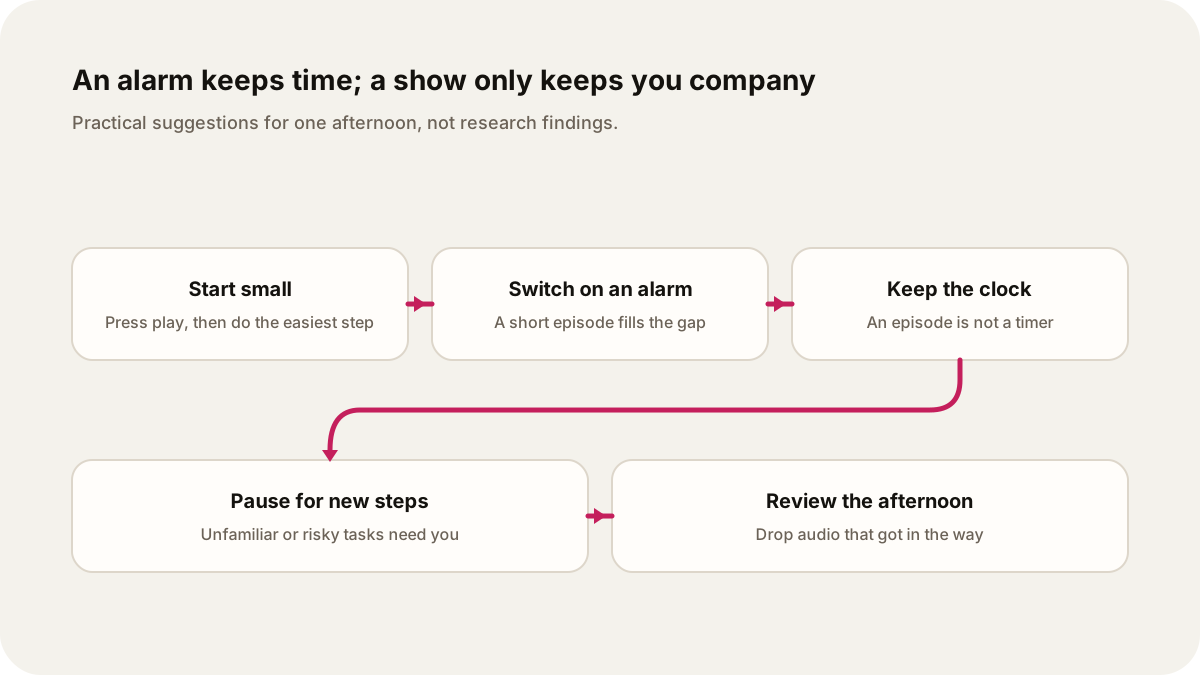
A voice you chose to hear can sit at the recorded end of that range. It can give a dull chore some company. It cannot notice that you stopped, help you decide what to do next, or tell you the time. Treat audio as an optional part of an afternoon, keep an alarm for timing and switching, and pause speech when the work needs your full attention. If ADHD is affecting your work, studies, or relationships, talk to a GP or an ADHD specialist; audio is not a replacement for assessment or treatment.
Original example and illustration: Lissin Editorial.
What body doubling means
The term came from neurodivergent communities rather than from a clinic. A 2024 study surveyed 220 people, most of them neurodivergent, and summarised the community's definition as using the presence of others to start, stay focused on, or accomplish a task. Their participants described body doubling at a café, with YouTube videos, and with friends or strangers. The tasks included studying, work, washing dishes, cleaning, and exercise. The reasons people gave were practical: building momentum and staying on task.
Two details from that survey matter for audio. First, participants counted both live and recorded company. Second, many had used the approach for years before they learned the name for it.
The authors place body doubling along two lines. One is space and time: the other person can be beside you or remote, live or recorded. The other they call mutuality. A show you play on your phone is remote and recorded, and it cannot respond to you.
What the research does and does not show
The evidence is small and comes mostly from accessibility and computing research, not clinical trials.
- A survey, not an outcome study. When the same team first presented this work in 2023, they wrote that no academic exploration of body doubling existed. Their survey records what people report doing. It was not designed to test whether body doubling improves anything.
- A small virtual reality experiment. In a 2025 preprint, 12 young adults screened for ADHD did a bricklaying task in virtual reality alone, with a human body double, and with an AI body double. They finished faster and rated their accuracy and attention higher with either companion. The study is small, uses one task, and has not been peer reviewed.
- A null result. A 2025 conference poster from Drake University compared a reading comprehension test done alone and with a body double, in three groups: people with ADHD taking medication, people with ADHD not taking it, and a neurotypical group. Body doubling had no significant effect on performance, focus, or calm. The authors note that a test may not capture the part people care about most: getting started and finishing.
None of these studies tested a podcast or audio show as a body double. So any benefit you notice from a recorded voice is your own experience, not a research finding.
The National Institute of Mental Health lists medication and psychosocial interventions, such as cognitive behavioural therapy, as standard ADHD treatments. The NHS adult ADHD page suggests seeing a GP when symptoms affect your studies, work, or relationships. Body doubling, with a person or a recording, is a self-help habit that sits alongside that care, not in place of it.
Starting a task
The Leicestershire Partnership NHS Trust offers practical tips for adults waiting for an ADHD assessment. They include starting for just five minutes, beginning with the easiest step, pairing a task with something enjoyable such as music, and doing tasks with another person. The trust presents these as things to try, not as tested treatments.
Audio fits the "pair it with something enjoyable" idea. Choose the episode before you start, so picking something does not become its own delay. Then let pressing play mean one small action: carry the laundry basket to the bed, or run the hot water. If you are still stuck after a few minutes, the show may simply be the wrong tool for that task.
Moving between tasks
Adults with ADHD often describe long periods of intense focus. In two samples of adults with and without ADHD, people with more ADHD symptoms reported more of this "hyperfocus" at school, in hobbies, and on screens. That evidence comes from questionnaires, and it says nothing about how to break out of a focused spell.
The NHS trust's suggestion for that moment is plain: set alarms to switch tasks. Let the alarm do the switching. A short, self-contained episode can then fill the gap between tasks, for example while you stand up, refill a glass, and clear the desk. Ask for a clear ending so it does not pull you into a series. That ending is a pause, not a signal you can rely on.
Keeping track of time
"Time blindness" is a popular description, not a diagnosis. The research behind it is narrower than the phrase suggests. A 2022 meta-analysis of 55 studies found that people with ADHD had more difficulty than people without ADHD on laboratory timing tasks lasting from fractions of a second to several seconds. A 2023 review of adult studies found only nine that met its criteria, with mixed results and a lack of validated instruments for measuring time perception in adult ADHD.
None of that tells you how a twenty-minute episode will feel. Treat a requested episode length as a target, not a timer. Pausing, replaying a section, or changing playback speed all change how long listening takes. If you need to leave at a set time, the NHS trust's advice applies: set an alarm to leave the house. Stopping partway through an episode is fine.
Getting through chores
Spoken audio suits tasks where your hands are busy and your mind has room. It suits reading and writing less well. A meta-analysis of 65 studies found that intelligible speech and music with lyrics were the most distracting background sounds during reading. For desk work, try silence or a steady non-speech sound; the guide to brown noise and pink noise for ADHD covers what that research does and does not show. To test speech against silence yourself, see whether spoken audio helps you focus.
For chores, pick a subject you can rejoin after an interruption. A straightforward explanation is easier to resume than a mystery where one missed sentence changes the plot. Pause for anything unfamiliar or risky, such as new instructions, sharp tools, or a hot pan. Having your hands busy does not leave your attention free. For matching an episode to the time and attention a chore needs, see audio for hands-busy moments.
A worked example: one afternoon
Here is an invented afternoon. Adjust every time and task to your own day.
- 1:30 pm, writing a report section. Silence or steady background noise, because speech competes with writing. An alarm is set for 2:15.
- 2:15 pm, the alarm goes off. Stand up and play a six-minute episode about how astronomical clocks worked. Refill your water and clear the desk while it plays. The alarm made the switch; the episode just fills the gap.
- 2:25 pm, laundry and the kitchen. Start a twenty-minute episode about the Panama Canal and begin with the easiest step: emptying the dishwasher. Pause it to read the label on a new cleaning spray.
- 2:45 pm, a second alarm for leaving at 3:00. Stop the episode wherever it is. Finish it on another day.
- Evening, a quick review. Did the show help you start the chores? Did you lose track of the report because of it? Keep what helped and drop what got in the way.
Make a show around it
In Lissin, you describe what you want to hear and choose the length, voice, pacing, and energy. You can make a one-time episode or schedule a recurring show that returns daily or weekly. Here is an example request for the chore block above:
Example request: Make a twenty-minute episode about how the Panama Canal was built, for listening while I do housework. Use one calm narrator, split it into short self-contained sections so I can rejoin after an interruption, and end with a clear conclusion.
Try the first few minutes during a real chore. If it does not fit, remix it with a shorter length, a slower pace, or a different voice. Lissin is an audio app, not an ADHD treatment, and a show does not replace the timers, support, or care that work for you.
Sources
- Eagle, T., Baltaxe-Admony, L. B., & Ringland, K. E. (2024). "It Was Something I Naturally Found Worked and Heard About Later": An Investigation of Body Doubling with Neurodivergent Participants. ACM Transactions on Accessible Computing: survey of 220 people, the community definition, live and recorded body doubles, tasks and motivations.
- Eagle, T., Baltaxe-Admony, L. B., & Ringland, K. E. (2023). Proposing Body Doubling as a Continuum of Space/Time and Mutuality. ACM SIGACCESS Conference on Computers and Accessibility: states that no academic exploration of body doubling existed at the time.
- Ara, Z., et al. (2025). You Are Not Alone: Designing Body Doubling for ADHD in Virtual Reality. arXiv preprint: 12 young adults screened for ADHD in a virtual reality task, not peer reviewed.
- Schuenke, R., & Moore, M. (2025). Evaluating the Efficacy of Body Doubling for ADHD Using a Brain-Computer Interface. CCSC Central Plains poster: no significant effect on performance, focus, or calm in a reading test.
- Hupfeld, K. E., Abagis, T. R., & Shah, P. (2019). Living "in the zone": hyperfocus in adult ADHD. ADHD Attention Deficit and Hyperactivity Disorders: self-reported hyperfocus and ADHD symptoms in adults.
- Marx, I., et al. (2022). Meta-analysis: Altered Perceptual Timing Abilities in ADHD. Journal of the American Academy of Child and Adolescent Psychiatry: 55 studies of laboratory timing tasks.
- Mette, C. (2023). Time Perception in Adult ADHD: Findings from a Decade. International Journal of Environmental Research and Public Health: nine adult studies, mixed findings, a lack of validated instruments.
- Vasilev, M. R., Kirkby, J. A., & Angele, B. (2018). Auditory Distraction During Reading: A Bayesian Meta-Analysis. Perspectives on Psychological Science: intelligible speech and lyrics as the most distracting background sound for reading.
- Leicestershire Partnership NHS Trust: ADHD strategies and support: practical tips for adults waiting for assessment.
- NHS: ADHD in adults: symptoms, when to see a GP, and treatment.
- National Institute of Mental Health: ADHD: standard treatments.