
A World Teachers’ Day audio lesson plan for 2026
Bring one checked explanation and one discussion question into the classroom.
For World Teachers’ Day on 5 October 2026, a teacher can prepare one short audio explanation for a class discussion and keep the rest of the lesson in their own hands. UNESCO says the 2026 observance marks 60 years of the 1966 ILO/UNESCO Recommendation concerning the Status of Teachers. Its theme is “Standing with teachers: 60 years of protecting the profession, advancing its status and shaping our futures.” (UNESCO)
That theme gives the date a useful starting point: ask what a teacher wants students to notice about professional status, working conditions, or the role of teachers in a changing education system. The audio is a preparation aid. It does not replace the teacher’s explanation, source checks, or decision about what belongs in the room.
Choose one question for the room
Start with a question that can be discussed in a few minutes. For example: “What does it mean to support teachers’ professional status?” That question is broad enough for different subjects, but it still gives the audio a job.
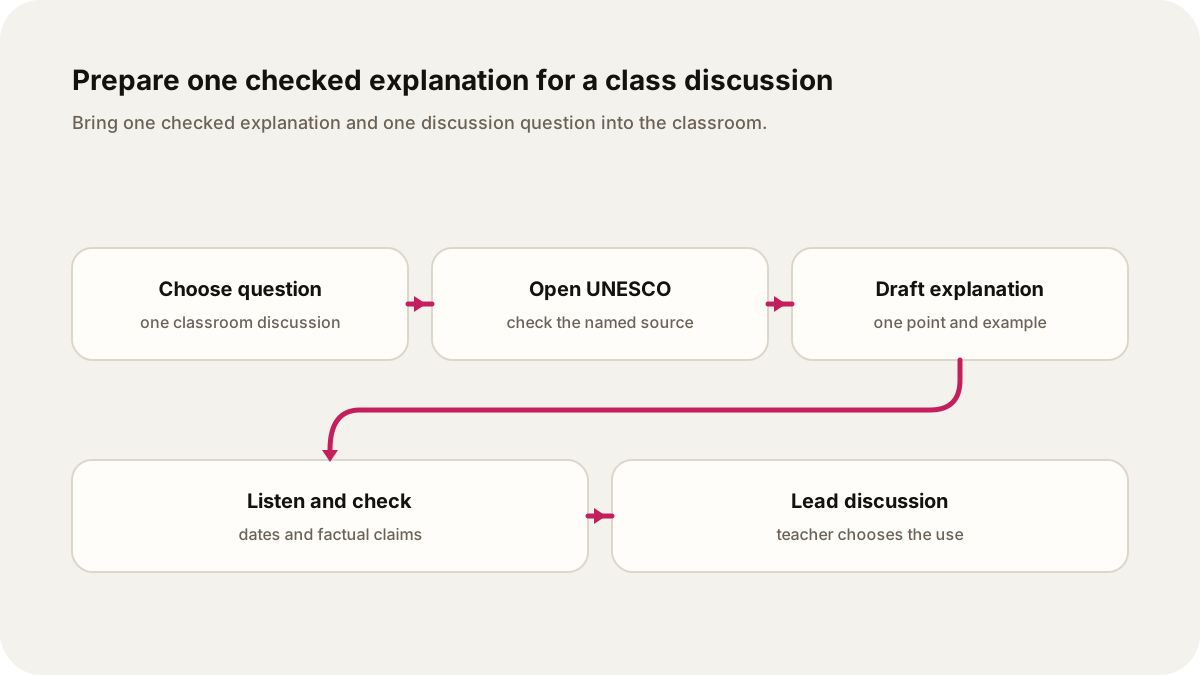
Write down the audience, the available time, and the one source the explanation must use. A teacher might choose UNESCO’s World Teachers’ Day page and ask for a 90-second explanation of the 1966 Recommendation, followed by two neutral questions. Keep the date and source in the note so an update does not become a hidden change to the lesson.
UNESCO describes the Recommendation as setting benchmarks for teachers’ rights and responsibilities, preparation and further education, recruitment, employment, and teaching and learning conditions. (UNESCO) Those are distinct topics. A short recording should name which one it covers instead of compressing all of them into a sweeping claim.
Prepare an explanation you can check
Prepare one audio explanation and one discussion prompt. A simple structure is:
- State the question and the date.
- Explain one point from the named source in plain language.
- Mark what the source says and what remains a discussion question.
- Ask students to compare the point with a local or personal example.
For a concrete example, take further education, one of the areas covered by the Recommendation. Ask the class to distinguish time for professional learning from a requirement to attend training outside working hours. UNESCO’s overview establishes the topic; it does not describe your school’s policy. Bring that policy separately if the discussion needs it.
Try this request in Lissin:
Create a 90-second spoken explanation for an adult teacher preparing a World Teachers’ Day discussion. Use only the UNESCO World Teachers’ Day 2026 page at https://www.unesco.org/en/days/teachers?hub=66657. Explain that 5 October 2026 marks the 60th anniversary of the 1966 ILO/UNESCO Recommendation concerning the Status of Teachers, and focus on one aspect of teacher status. Separate sourced statements from two open discussion questions. Say when a point is a question rather than a fact. Do not claim that listening proves learning. Keep the explanation suitable for an adult teacher, with one concrete example.
Listen to the episode and check it against UNESCO’s page before using it in class. You decide what belongs in the discussion.
Listen as an editor
Play the draft once with the source open. Pause at each date, name, number, and statement about cause or impact. Check that the audio says “UNESCO describes” when it is summarizing UNESCO’s position. Check that a discussion question does not sound like a settled finding.
Then shorten anything the teacher would have to explain again. The finished recording can be a private preparation note, a teacher-led introduction, or an optional listening station chosen by the teacher. Keep the preparation in the teacher’s account and follow the school’s device, privacy, and accessibility rules when choosing material for students.
For a class discussion, bring the source link, the transcript, and one question that has no single answer. The teacher can decide when to stop the audio, correct a detail, or replace it with their own explanation. Write the chosen question on the board before pressing play. After the introduction, ask students which part of the source they would open to check the example.
Sources
- World Teachers’ Day, UNESCO: date, 2026 anniversary, theme, and scope of the 1966 Recommendation.
- World Teachers’ Day 2026 global celebration, UNESCO: official event details and co-convening organizations.
- Lissin for iPhone.