
Brown noise vs. pink noise for ADHD: what the evidence supports
Noise colors describe sound spectra. A listener's preference for brown or pink noise does not establish an ADHD treatment, and findings from white-noise tasks should not be generalized beyond their evidence.
Brown and pink noise sound different, but a preferred sound is not evidence of an ADHD treatment. The studies below concern white noise and specific cognitive tasks, mainly in children. They do not establish that brown noise is better than pink noise for adults with ADHD.
What the colors describe
White, pink and brown describe how a noise signal distributes power across frequencies. White noise has a flat power spectrum; pink noise puts relatively more power at lower frequencies, and brown noise slopes downward more steeply. These descriptions concern the sound signal, not a clinical benefit.
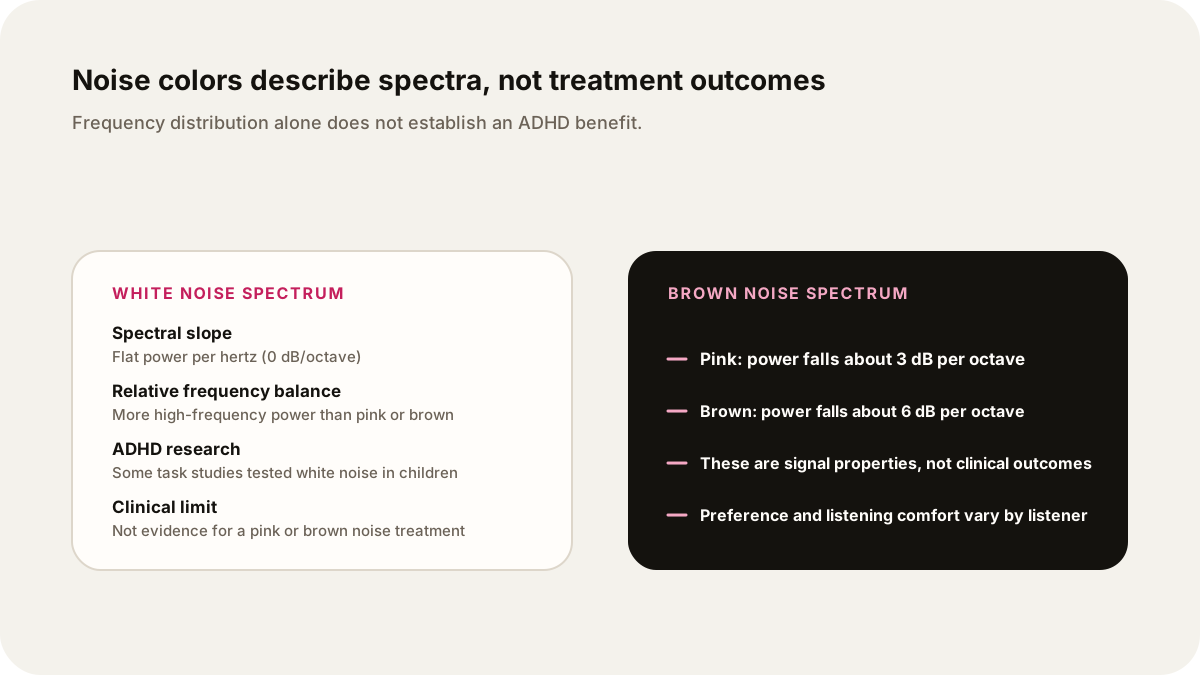
A listener may find one sound more comfortable than another. That preference does not prove that the sound improves attention, prevents sensory fatigue or protects hearing. Volume and listening duration still matter for every color.
What the research actually tested
Söderlund, Sikström and Smart (2007) studied a memory task in children with and without ADHD. White noise improved performance in the ADHD group and impaired it in the comparison group. This was a particular task and sample, rather than a comparison of pink and brown noise or a demonstration of lasting symptom improvement.
Sikström and Söderlund (2007) proposed a model connecting arousal, dopamine and stochastic resonance. In this model, an appropriate amount of noise can help a weak signal be detected. A proposed mechanism does not establish which sound a particular listener should use, or turn a background-noise playlist into treatment.
Helps and colleagues (2014) tested white noise in schoolchildren grouped by teacher-rated attention. Effects differed across groups and tasks. This makes a universal recommendation especially difficult: a sound that helps one group can interfere with another.
These findings should not be generalized into a claim that lower frequencies soothe an ADHD nervous system, that white noise inevitably causes fatigue, or that brown noise outperforms pink noise. The sources cited here do not support those claims. Evidence for a specific noise color, adult ADHD symptoms and everyday work would need to be assessed separately.
Choosing a background sound
If you already use background sound, treat the choice as a comfort preference. Compare a short work period with quiet, pink noise and brown noise at a comfortable level. Notice whether the sound helps you start the task or makes it harder to follow what you are doing. Stop if it is distracting or uncomfortable; there is no need to persist with a popular sound.
Sound is not a substitute for assessment or prescribed care. Discuss persistent attention difficulties or distress with a qualified health professional.
For hearing safety, keep the volume low and take breaks. Making the noise louder to cover every interruption can increase exposure. The WHO–ITU safe-listening standard considers both level and duration; a noise color alone does not make listening safe. Seek medical advice for persistent ringing, pain or hearing changes.
Where Lissin fits
Make a personal show from a topic, question, or source in Lissin, or choose an existing show. A show is a listening option, not an ADHD treatment or a clinically validated noise intervention.
Correction
This guide was corrected on September 30, 2026. Earlier text linked to mismatched papers and described an adult pink/brown-noise trial that the cited source did not substantiate. Those references and the unsupported treatment, fatigue and headphone-pressure claims have been removed.
Sources
- Söderlund, G., Sikström, S., & Smart, A. (2007): Listen to the noise: noise is beneficial for cognitive performance in ADHD.
- Sikström, S., & Söderlund, G. (2007): Stimulus-dependent dopamine release in attention-deficit/hyperactivity disorder.
- Helps, S. K., et al. (2014): Different effects of adding white noise on cognitive performance of sub-, normal and super-attentive school children.
- WHO–ITU (2019): Safe listening devices and systems.