
What happened to personalized news apps, and what AI audio changes
An app closing, an experience moving, and a technology being acquired are different outcomes. The product record matters more than a story of four failures.
NPR One moved into another app. Artifact stopped operating independently, then its technology was acquired by Yahoo. Listeners reported Spotify's Daily Drive disappearing, while Amazon still publishes instructions for building Flash Briefings. Calling all four products dead hides the differences a listener needs to understand.
Some personalized news experiences end; others change ownership, interface or delivery. AI-generated briefings add another option: describing the episode you want instead of choosing only among existing segments. That changes the listener's control, but does not by itself explain earlier product decisions or predict which service will last.
Original illustration: Lissin Editorial.
What happened to the earlier products
| Product | What the public record supports | What it does not establish |
|---|---|---|
| NPR One | NPR announced that its experience was moving into the NPR app | That personalized public-radio listening was abandoned |
| Artifact | Yahoo acquired the technology in March 2024 and announced plans to integrate it | That the underlying personalization technology disappeared |
| Spotify Daily Drive | A secondary report describes listeners losing access | A confirmed universal retirement date, cause or successor |
| Alexa Flash Briefing | Amazon continues to publish an overview and developer instructions | Whether investment, usage or long-term support is increasing or declining |
NPR One: a move between apps
NPR's announcement, carried by WBUR, described moving the NPR One experience into the NPR app. RAIN News subsequently reported the separate app's retirement. The distinction is practical: someone looking for the listening experience needs the new destination, rather than a conclusion that the whole approach failed.
These announcements do not supply an economic analysis of personalized audio. Consolidating apps is not enough evidence to infer that producing a personalized stream was unprofitable.
Artifact: an app ended, its technology continued
Artifact was primarily a personalized news reader, so it is an adjacent comparison rather than an equivalent to a daily audio briefing. TechCrunch reported its planned shutdown in January 2024. But that was not the end of the record.
Yahoo announced the acquisition on April 2, 2024, saying the transaction closed on March 29. Its announcement said the app would no longer operate independently and that its personalization technology would be integrated into Yahoo products, including Yahoo News. A standalone service ending and a buyer continuing its technology are different outcomes.
Daily Drive: reported disappearance, uncertain explanation
Distractify reported listeners noticing Daily Drive's disappearance. That is a secondary account of availability, not an official explanation of a worldwide retirement. The sources here do not establish why Spotify changed it or whether AI DJ replaced it. Those possibilities should not be presented as product history.
For a listener, the immediate task is to find the news programs behind the playlist, where they are identified, and check whether their own feeds remain available. A missing playlist need not mean every publisher in it stopped producing audio.
Flash Briefing: still documented
Amazon's Flash Briefing overview describes supplying regularly updated audio or text feeds and letting listeners request their briefing through Alexa. Its developer instructions still describe creating and submitting a skill.
The deprecated-features page does not justify treating another documented capability as abandoned. Documentation is not a usage chart or a guarantee of future support, but it gives no basis for counting Flash Briefing as a fourth shutdown.
What generated briefings change
There are two different ways to personalize audio. A system can select and order existing episodes or segments. It can also generate an episode from a topic, source collection or instruction. Services can combine those approaches; the distinction is about the work done for a particular request.
Spotify's announcement of Studio by Spotify Labs describes a standalone desktop app that can research topics, connect with permitted personal tools and produce private audio such as daily briefings. A July 20, 2026 update says its research preview began a gradual rollout. Availability should be checked before planning a routine around it. Spotify also warns that the preview can make mistakes and results need verification. Its podcast-feature announcement distinguishes Personal Podcasts from other podcast features.
Earlier reporting also covered Google's Daily Listen, The Washington Post's personalized podcast and Particle's audio feed. The original reports are retained below as historical context. They are not a current comparison of availability, pricing or controls; those details require checking with each provider.
A typed brief can make the desired length, subject and editorial direction explicit. It does not prove lower production costs, better factual accuracy or stronger retention. The sources cited here do not compare those outcomes across the old and new products.
Choose for the routine you can sustain
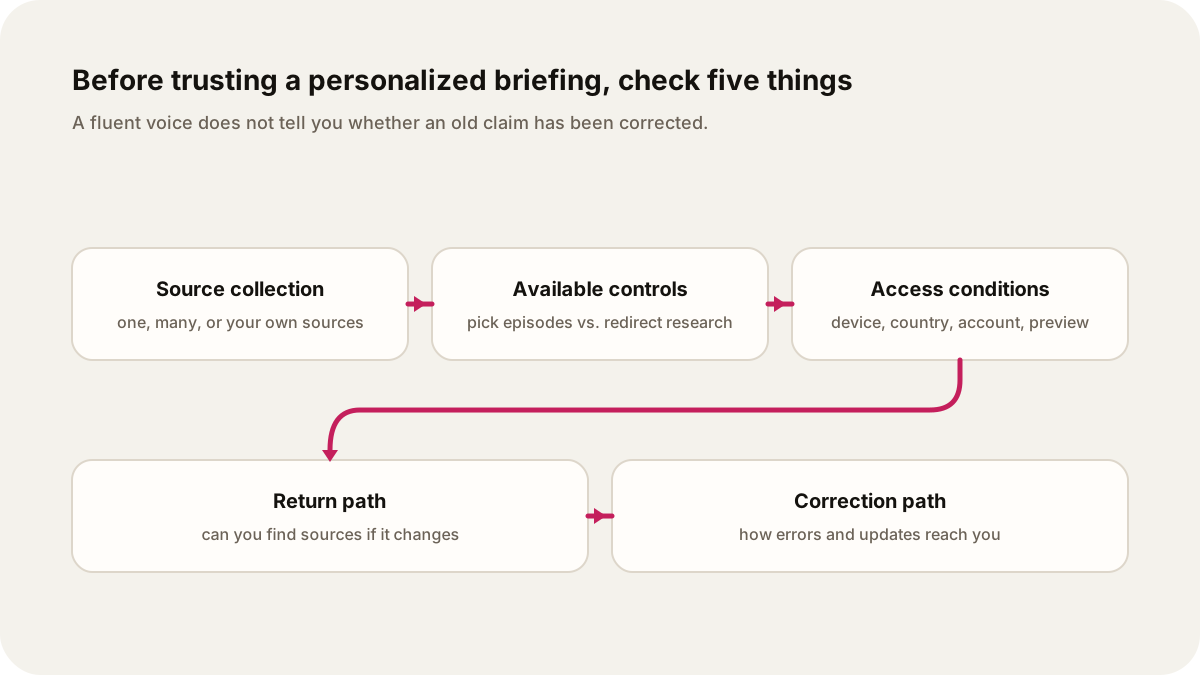
Before building your day around a personalized briefing, check five things:
- The source collection. Does it use one publisher, several publishers or sources you supply? Can you identify the reporting behind an important claim?
- The available controls. Distinguish choosing an existing episode from changing what gets researched or written. Try the particular adjustment you need.
- The current access conditions. Check device, country, account and preview restrictions. An announcement does not mean every listener can use the feature.
- The return path. Can you find the underlying publications, saved episodes or source list if the interface changes? Do not assume export or podcast-feed support unless the service documents it.
- The correction path. Check how errors or later developments reach you. A fluent voice does not tell you whether an old claim has been corrected.
Source range needs its own check. Explicit topic choices can still omit important reporting, and different logos may repeat one account. Our guide to personalized news and echo chambers explains how to distinguish relevance from narrowing. Also consider whether you want a finite edition or another queue to keep skipping through; switching between shows raises a different listening problem from choosing the right briefing.
In Lissin, you choose the topics and sources, the presentation, the voice, and the length. Make one episode or a recurring show, then ask for changes after listening. Hear an existing show or make one around the question you want answered.
Keep a copy of the sources and questions that make your briefing useful. If the app changes, that list gives you somewhere to start again.
Sources
Correction, 6 September 2026: an earlier version grouped these products as four failures. The record includes a migrated experience, acquired technology, a reported disappearance with an unconfirmed cause, and a capability that remains documented.
Primary product records checked in September 2026:
- NPR One is moving, NPR announcement carried by WBUR.
- Yahoo's Artifact acquisition announcement, April 2, 2024.
- Amazon Flash Briefing overview, creation instructions, and deprecated features.
- Studio by Spotify Labs, May 21 announcement with July 20, 2026 rollout update, and podcast feature announcement.
Earlier secondary reports, useful for the events or announcements they describe rather than current feature guarantees:
- RAIN News, NPR sunsets the NPR One app.
- TechCrunch, Artifact to shut down, January 12, 2024.
- Distractify, What happened to Daily Drive?.
- Entrepreneur, Google's Daily Listen.
- TechCrunch, Spotify's briefing and Q&A announcement, May 21, 2026.
- Digiday, The Washington Post's personalized podcasts.
- TechCrunch, Particle's podcast and audio features, February 23, 2026.