
NBA goaltending vs. basket interference: what is the difference?
A shot can be rising and still be protected. Follow the ball's flight, backboard contact, cylinder, rim, and net to understand the call.
When a defender swats a shot near the rim, the question is not simply whether the ball was above the basket. NBA officials consider the ball's flight, the imaginary cylinder above the ring, backboard contact, and rim or net contact.
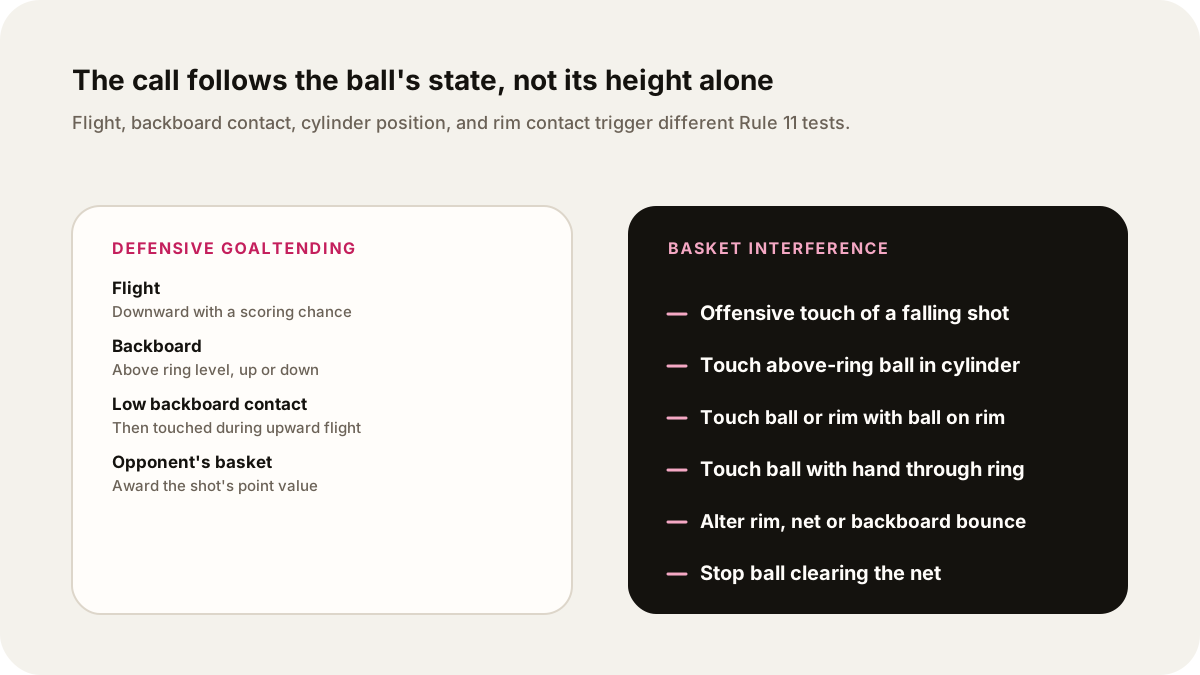
The short answer: Goaltending is an illegal defensive touch of a scoring shot, especially on its downward flight. Basket interference is illegal contact with the ball, ring, net, or cylinder. The exact contact matters more than the label.
What counts as goaltending?
The clearest case is a defender touching a ball from the playing area while it is on its downward flight and has an opportunity to score. NBA Rule 11 calls this a field-goal attempt. A defender cannot wait for the shot to begin falling and then erase it above the rim.
The rule also covers shots after the ball hits the backboard. If the ball touched any part of the backboard above ring level and still has a chance to score, a player cannot touch it on either its upward or downward flight. If it touched below ring level, the restriction applies while the ball is rising.
An offensive player can also violate the downward-flight restriction. The NBA Rule Authority example labels that touch offensive basket interference. Name the touching player’s team before naming the call.
What makes basket interference different?
Basket interference is about the basket area and the equipment as well as the shot's flight. A player may not touch a ball above the ring and inside the imaginary cylinder. The cylinder is the vertical space bounded by the ring, so a ball that is still moving upward can be protected once it enters that space.
Rule 11 also forbids touching the ball or ring when the ball is sitting or rolling on the ring, touching the ball with a hand through the ring, or touching the rim, net, or ball while the ball is in the net if that prevents it from clearing. Bending or vibrating the rim, net, or backboard to cause an unnatural bounce is also prohibited.
There is a narrow exception. A player near their own basket may keep a hand legally in contact with the ball as the ball enters the cylinder, and that continued contact can include touching the basket.
A worked court example
Imagine Team A shoots a two-point floater. The ball rises, kisses the backboard above ring level, and starts down toward the rim. A Team B defender blocks it before it reaches the ring. That touch is illegal because the ball had a chance to score after touching the backboard above ring level, regardless of whether the defender met it on the way up or down.
Change one detail. The defender blocks the same shot while it is rising, before it touches the backboard or enters the cylinder. That can be a legal block.
Now picture the ball rolling around the rim. A Team A player taps it away while it is using the ring as its lower base. That is basket interference. If the ball falls through after the tap, the referee does not wait to see whether the tap helped. The contact itself is the violation.
How the NBA applies the penalty
At the opponent's basket, the offended team receives the value of the attempt: two points from the two-point zone or three points from the three-point zone. The official then gives the ball to a player of the team entitled to the throw-in.
At a team's own basket, no points are scored and the offended team receives the ball at the free-throw line extended. If both teams violate the rule, play resumes with a center-court jump ball.
That is why an offensive tip-in can cost a team a basket even when the ball eventually drops. A defensive goaltend can award points without the ball finishing in the net.
A quick way to judge a replay
Pause the clip at the first illegal-looking contact and ask five questions:
- Was the touching player on offense or defense?
- Was the ball still a shot with a chance to score?
- Was it rising or falling?
- Had it touched the backboard, and above or below ring level?
- Was it in the cylinder, on the ring, in the net, or being affected through the rim or backboard?
The answers usually separate a legal block from goaltending or basket interference. Do not use “above the rim” as the whole test. One change in sequence can change the ruling.
For another rules explanation built around a clock state, see how the NBA shot clock changes from 24 to 14 seconds. Football offside is a different sport and a different timing problem, but it uses the same useful habit: identify the exact moment the restriction becomes active. Cricket follow-on offers another example of keeping a threshold separate from the result that follows it.
When you listen to a replay explanation, ask the narrator to name the ball's flight, backboard contact, cylinder position, and the exact Rule 11 remedy. Those details make a disputed rim play understandable without guessing from the slow-motion image.
Sources
- NBA Official 2025–26 Playing Rules, Rule 11: the published 2025–26 Rule 11 language for goaltending, basket interference, exceptions, and penalties.
- NBA Rule Authority: Basket Interference and Goaltending: NBA explanations and examples of the rule, including contact while the ball is rolling off the rim.
- NBA Rule Authority: Goaltending and Basket Interference: league explanation of the imaginary cylinder and rim-contact example.