
How to read library call numbers: Dewey Decimal vs. Library of Congress
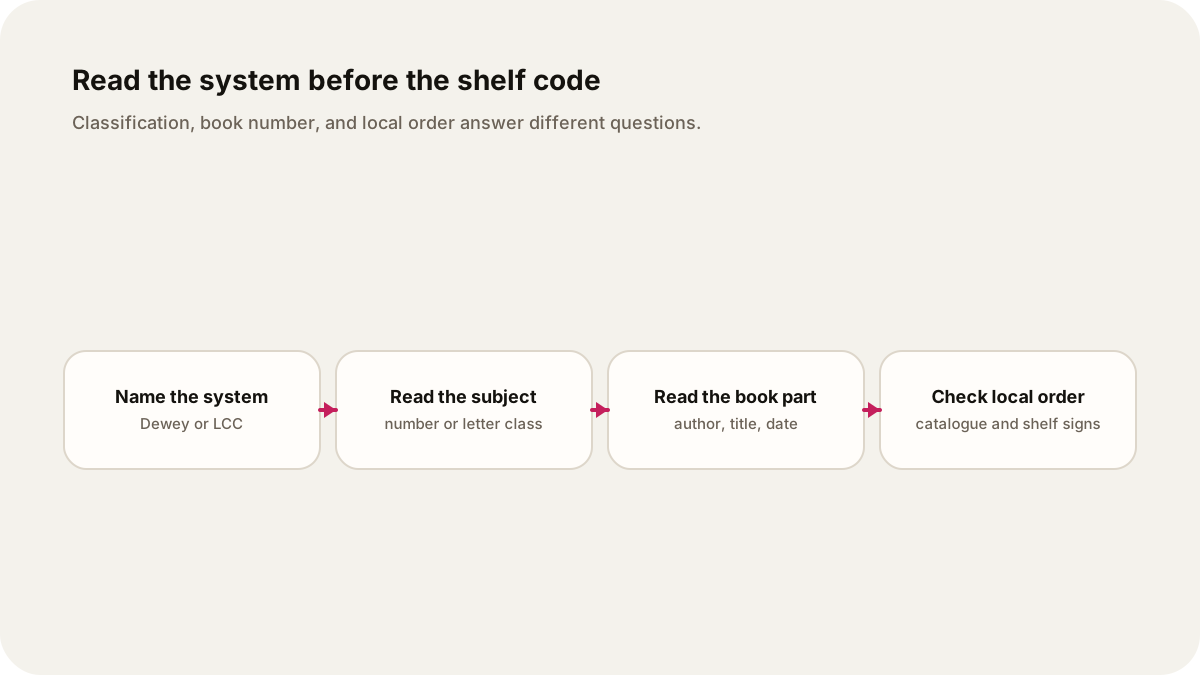
Read the system first, then the subject code, book number, and local filing clues. Dewey and Library of Congress labels organize shelves in different ways.
When you see 005.133 or PS3563.O874, you are looking at a shelf address built from a classification system, a book number, and sometimes a date or other local detail. The letters and digits are not a universal rating of the book. They help a particular library arrange its collection so that related works can sit near one another.
Key takeaways
- Dewey Decimal Classification (DDC) uses Arabic numerals in a hierarchy of ten main classes, then divisions and sections.
- Library of Congress Classification (LCC) begins with letters for broad subject classes and adds numbers and a book number for a more specific shelf position.
- A call number identifies an item in a library's arrangement. It does not, by itself, prove that two books cover the same question or that one book is better.
A call number is a location clue
The Library of Congress explains that call numbers are a main way libraries provide subject access and the primary method for locating physical items on shelves. A classification number represents a subject or form. A complete call number adds information that distinguishes one item from another.
That distinction matters when you search a catalogue. A record might show a classification number shared by several books, then a cutter or other book number that places each title in a local sequence. The label on the spine is therefore a compact instruction for finding the item. It is not a summary of the entire contents.
For example, imagine a public library label that reads 005.133 MAR 2024. Treat this as a hypothetical label, not as a record for a real book. The first part is a Dewey number whose exact caption should come from the catalogue. MAR could be the library's author or title arrangement, and 2024 could separate an edition or publication year. Check the catalogue before you claim what each local segment means.
How Dewey Decimal Classification works
OCLC's introduction to DDC describes a system with ten main classes. Each class divides into ten divisions, and each division into ten sections, creating a decimal hierarchy. The notation uses Arabic numerals, so the early part of a label can be read as a narrowing subject path.
The decimal point does not mean the number is a measurement. It separates the broad number from further digits that refine the topic. A library may use a shorter or longer number depending on its collection and classification practice. The full DDC schedules contain more detail than a visitor needs for ordinary shelf reading, so do not infer an exact topic from a few digits unless the catalogue supplies the caption.
Try this listening order:
- Say the number in groups: “zero zero five point one three three.”
- Read the catalogue subject or class caption beside it.
- Read the author or title letters as a separate shelf-order clue.
- Check the library's instructions for editions, copies, large print, or local prefixes.
In a DDC collection, nearby books may share a broad subject while differing in audience, language, format, or treatment. The number makes browsing possible. It does not replace the title, contents note, or subject headings.
How Library of Congress Classification works
The Library of Congress Classification outline starts with broad lettered classes such as H for social sciences, P for language and literature, and Q for science. It then uses subclasses and numbers to place material more precisely. The LOC FAQ contrasts LCC with DDC: LCC uses combinations of letters and numbers, while DDC uses Arabic numerals in a decimal hierarchy.
Consider another hypothetical label: PS3563.O874 B6 2021. The opening PS is used for American literature in LCC guides such as Fordham University's call-number guide. The remaining elements refine the author and work in that library's sequence. The example is for learning the shape of a label. It is not a claim about a particular author, edition, or catalogue record.
Say the label in layers rather than as one long code:
| Part | What to ask | What to avoid assuming |
|---|---|---|
| PS | Which broad LCC class is this? | That the two letters name the whole book |
| 3563 | What subclass or number does the catalogue describe? | That the number has the same meaning in DDC |
| .O874 | What book-number or cutter rule is in use? | That every library files it identically |
| B6 | What work or title detail follows locally? | That it is a universal abbreviation |
| 2021 | Is this a publication or shelflisting date? | That every date on a label has the same job |
The LOC Classification and Shelflisting Manual treats classification and the unique book number as separate parts of the work. For a visitor, the practical lesson is simple: use the catalogue record and the shelf signs together. A code that looks familiar can still follow a local filing rule.
Dewey versus LCC: which label should you expect?
There is no reliable rule that every public library uses DDC or every academic library uses LCC. Libraries choose systems for their collections, history, users, and operating practice. A branch may also use local prefixes, separate children’s areas, genre labels, or a different arrangement for fiction.
| Question | Dewey Decimal Classification | Library of Congress Classification |
|---|---|---|
| Opening signal | Arabic numerals, often with a decimal | One or more letters followed by numbers |
| Broad structure | Ten main classes, then divisions and sections | Lettered classes with subclasses and expanding schedules |
| Useful first move | Read the number and the catalogue caption | Read the letter class and the catalogue caption |
| Common mistake | Treating digits as a complete subject description | Treating the letters as a complete call number |
The systems can describe similar material through different paths. A history book may sit in one broad number in a DDC branch and in a lettered history class in an LCC research library. That difference is an arrangement choice, not evidence that the libraries disagree about the book.
Build an audio guide from a label
If you want Lissin to explain a shelf label, give the episode one question and the catalogue record beside the photograph. The museum object guide uses the same evidence boundary for an object record: physical details, documented history, and interpretation need separate labels. A call-number guide adds one more layer, local shelf order.
Use this illustrative request after the qualifier above the block:
Explain the call number 005.133 MAR 2024 as a hypothetical Dewey example, then compare its shape with the hypothetical LCC label PS3563.O874 B6 2021. State that both labels are teaching examples, not records for real books. Explain the broad classification part, the book-number part, and the reason a catalogue record is needed before assigning a meaning to a local suffix or date. Keep Dewey's decimal hierarchy separate from LCC's lettered classes. Do not reproduce a full classification schedule, identify an imagined author, or claim that a shelf arrangement proves a book's quality.
For the finished episode, include the library's catalogue URL, the label photo, and the location or collection name. Ask the narration to read the code slowly, repeat the catalogue caption, and say when a meaning is local or uncertain. A shelf label without its catalogue context can show the form of a call number, but it cannot settle every filing rule.
That source trail also makes corrections easier. If the library relabels a collection, update the local instruction and keep the general explanation separate. For a broader source-led audio workflow, see how to make a show around your question. If you need to compare several pages or records, PDF to podcast: choose the pages and definitions first shows how to keep selected evidence beside the request.
Sources
- Library of Congress, Classification and Shelflisting, official classification resources and schedules.
- Library of Congress, Classification Outline, broad LCC classes and subclasses.
- Library of Congress, Dewey FAQ, official comparison of LCC and DDC.
- OCLC, Introduction to the Dewey Decimal Classification, DDC hierarchy and notation.
- Library of Congress, Task Group on Automated Classification, call numbers as shelf-location and subject-access tools.
- Fordham University Libraries, Using Call Numbers, a university example of reading LCC parts and shelf order.
The labels in this guide are hypothetical teaching examples. They are not catalogue records or claims about a specific library's filing policy. Check the library catalogue and shelf signs for the item in front of you.