
Can AI audio help with local news deserts? What the evidence shows
A local audio briefing needs reporting to work from. Check which sources exist before asking what AI narration can add.
AI audio can turn existing local reporting into something a resident can listen to. It cannot supply the interviews, observation or scrutiny that never happened. Before asking whether it can help a news desert, check what reporting is available for it to use.
The distinction matters when choosing a local briefing. A short episode built from a council agenda can explain what is scheduled for discussion. It cannot tell you what happened at the meeting unless a record or report of that meeting exists.
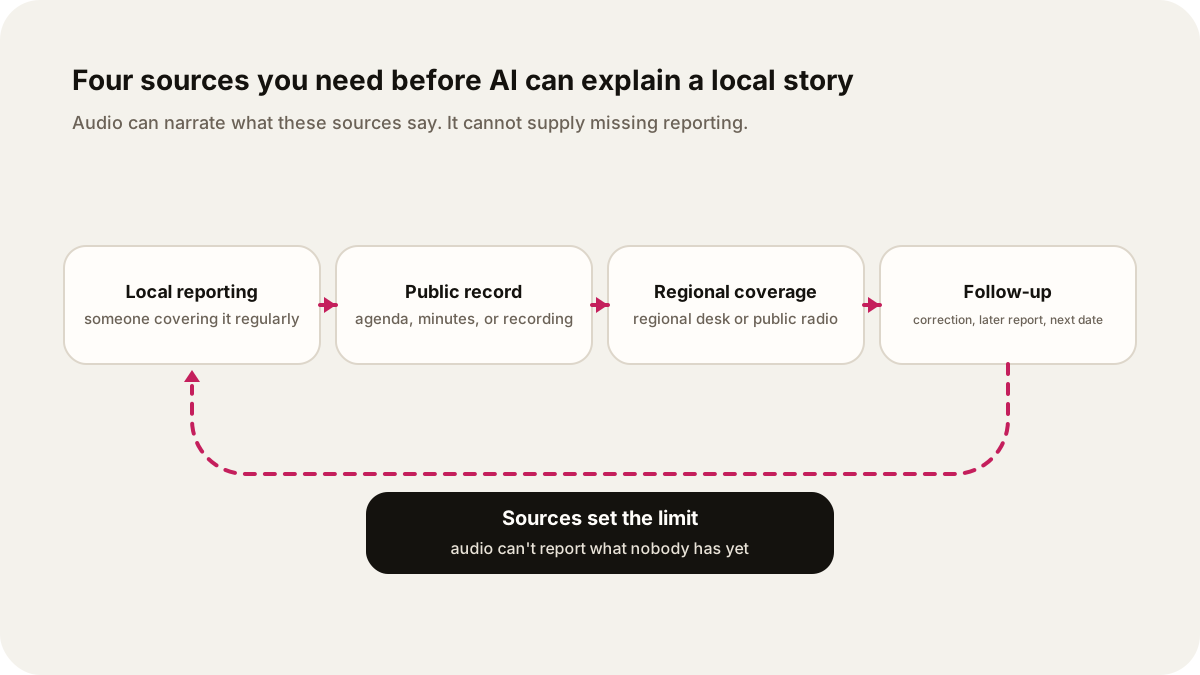
Original illustration: Lissin Editorial.
What the local-news data shows
Northwestern University's 2025 State of Local News report identifies 212 U.S. counties with no locally based news source and another 1,525 with only one. Together, these counties contain roughly 50 million people.
News deserts and newspaper losses describe different measures. Almost 80 percent of the desert counties are predominantly rural. But nearly 70 percent of the newspapers that disappeared since 2005 were in predominantly urban counties, where there were more papers to lose. Those findings do not establish that local news is disappearing fastest in mid-size cities.
The report also counts 695 stand-alone digital outlets, up from 662 the previous year. That category includes former newspapers that stopped printing. An increase in digital outlets should not be read as the same increase in newly created reporting capacity.
Public radio provides another source of coverage. Northwestern finds that signals reach 82 percent of news-desert counties when repeaters are included. Signal coverage does not mean a station has a reporter assigned to every county it reaches.
National podcast demand does not answer the local question
Pew Research Center's 2025 podcasts and news fact sheet reports that 32 percent of U.S. adults get news from podcasts at least sometimes, compared with 22 percent in 2020. The measure covers podcast news generally. It does not establish demand for AI-generated city or county briefings.
Neither of these reports tests whether residents of news deserts become better informed by using personalized audio. A local trial would need to ask which residents use it, which sources the episodes rely on, what gaps remain, and whether listeners can identify the developments that affect them. Downloads alone would not answer the last question.
The case for audio is therefore a distribution proposal: make available reporting usable during a walk, commute or household task. It is not evidence that a missing newsroom has been replaced.
Audit the sources before choosing the format
Pick one subject you want to follow, such as a school-board decision or a local transport change. Then fill in this source card:
| Source role | What to find | What it can leave out |
|---|---|---|
| Local reporting | A reporter or outlet covering the subject regularly | Matters beyond its beat or staffing capacity |
| Public record | The relevant agenda, minutes, recording or published decision | Unrecorded conversations, disputed interpretations and independent scrutiny |
| Regional coverage | A regional newsroom or public-radio report | Street-level details outside its regular coverage |
| Follow-up | A correction page, later report or next meeting date | Developments that nobody has reported yet |
Check the last publication date, the named reporter or issuing body, and whether the story contains original reporting. Three websites repeating the same statement provide one account. An agenda is a plan; minutes and reporting may describe what actually happened. If all you can find is the agenda, keep that limitation in any summary.
For a continuing issue, save the card with a dated background note and update log. It lets you see whether the next briefing adds evidence or repeats a source you already read.
Where generated audio can help
When sources exist, a listener can request a shorter explanation, unfamiliar terms defined, or a briefing focused on the question they are following. Generating narration can change the work involved in producing audio, but research, generation, review and distribution still have costs. It does not make reporting free.
Try this request: “Explain this week’s transport decisions using the local reports and official documents I provide. Separate proposals from final decisions. Name the dates and explain what remains unknown.” Check the resulting episode against those sources.
Listen for omissions as well as errors. Did a proposal become a decision in the narration? Did the speaker imply that two copied articles independently confirmed a claim? Did the episode turn an institution's statement into an established fact? The AI-summary verification guide gives a method for checking those changes.
Choose the topic and local sources in Lissin, then decide whether you want one episode or a recurring show. Keep the original reporting available. The episode cannot establish that every relevant local source was found or accessible. You can hear existing shows on the web before making your own.
Keep the reporting visible
A useful local briefing should leave the listener able to identify the outlet or document behind its claims and return to the original work. Where possible, keep the reporter's name, publication date and link beside the audio. Follow corrections at the source, and support the reporting you depend on through the outlet's own channels.
Personalization has an uneven product history, covered in our review of personalized news apps and audio. A convenient interface can change how someone encounters a report; it does not establish why a product succeeds or whether a community's coverage improves.
Start with one local question and the sources that can answer it. If the reporting is missing, keep the gap visible. If it exists, choose a finite listening or reading routine that brings you back to those sources when the details matter.
Sources
Correction, 6 September 2026: an earlier headline said local news was disappearing fastest in mid-size cities. The cited county-level report does not establish that comparison. This article now distinguishes newspaper losses, source availability, and the limits of audio distribution.
- The State of Local News 2025, Local News Initiative, Medill School of Journalism, Northwestern University: county-level availability, newspaper losses, digital outlets and public-radio reach.
- Podcasts and News Fact Sheet, Pew Research Center: U.S. adults' reported podcast-news use. This is not an evaluation of local AI audio.
- Abernathy, P. M. (2023), "The State of Local News: Preserving Local Journalism in the Digital Era": Northwestern University Medill School of Journalism analysis on news deserts and civic information gaps.
- Federal Communications Commission (2020), "Information Needs of Communities: The Changing Media Landscape in a Broadband Age": federal study on local reporting deficits across underserved counties.