
Hacker News and Reddit: make a weekly audio digest
Give a forum digest one question to answer. Keep posts, comments and original reporting separate, then check the claim that matters before acting on it.
To turn Hacker News and a few subreddits into a weekly audio digest, start with one narrow question, add only the sources that discuss it, and schedule a recurring show that returns each week. Then check one claim per episode against the original thread or the article it links to. Lissin can follow subreddits and Hacker News as sources. A show can return daily, weekly or every two weeks (Lissin for iPhone, retrieved 2026-10-16).
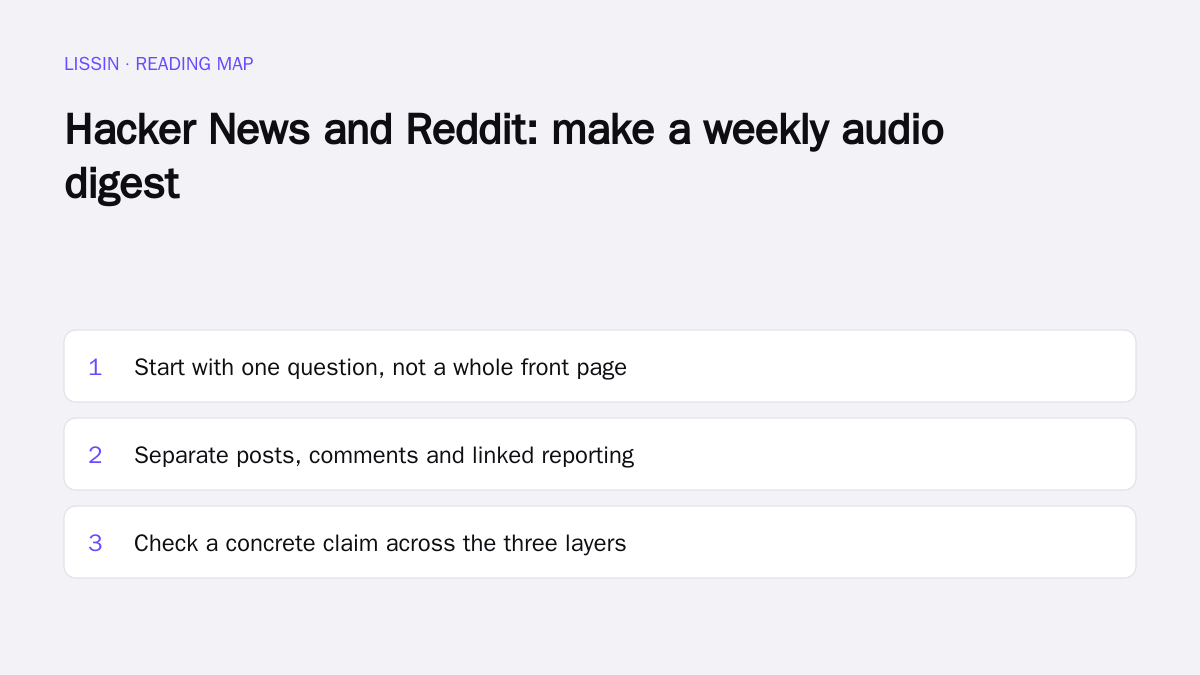
Most of the work is deciding what the digest is for, so a week of busy threads becomes an episode that fits your walk.
Key Takeaways
- Give the show one question it can answer each week, not "everything on Hacker News".
- Treat posts, comments and linked articles as different kinds of evidence.
- Try weekly if a weekly view fits the question. Waiting does not verify a thread.
- Check one consequential claim per episode against its source, and keep the link you checked.
Start with one question, not a whole front page
A forum front page changes constantly and mixes launches, arguments, jokes and job posts. If you ask for all of it, you get a summary of whatever was loud that week. A question gives the show a filter.
Good digest questions are narrow enough to have an answer most weeks and open enough to change over time. Compare:
| Too broad | Narrow enough |
|---|---|
| "What's happening in tech?" | "What did people building with local language models report this week, and what problems keep coming up?" |
| "Summarise my subreddits" | "Which tools did people in these two communities recommend for home server backups, and why?" |
| "Hacker News highlights" | "Which new developer tools got serious discussion, and what were the main objections?" |
The narrow versions tell the show what to notice and what to skip. You can choose a skeptical or practical lens and tell Lissin what to notice, question and leave out (Lissin for iPhone). For forum sources, a skeptical lens is often a sensible default, because confident comments are not the same as tested claims.
If your interest is role-based rather than topic-based, the software engineer briefing shows a wider starting point you can narrow from.
Separate posts, comments and linked reporting
A thread contains at least three kinds of material, and each supports a different kind of statement. Mixing them is where forum summaries tend to go wrong.
| Material | What it can support | What it cannot support on its own |
|---|---|---|
| The post or submission | That someone shared a link or made a claim on a date | That the claim is true |
| Comments | That some participants hold a view, report an experience or raise an objection | That the view is widespread or correct |
| The linked article, release note or paper | What that source says | What commenters think of it |
A useful digest says which layer a point came from. "The release notes say version 3 drops support for X" is a different statement from "several commenters said the upgrade broke their builds". You can ask for that distinction in your show description. Listen for whether each episode keeps it; do not assume it will.
This matters most for numbers. A benchmark figure quoted in a comment may come from the linked article, from the commenter's own test, or from nowhere. Our guide on how to verify an AI-generated news summary covers how to trace a number back to where it started.
Check a concrete claim across the three layers
Imagine a fictional release note says version 3 now requires runtime 20. A comment says "the upgrade broke my app," but does not say which runtime that person used. A useful digest can report both statements. It cannot conclude that version 3 is broken for everyone, or that the runtime change caused that person's failure.
Check the release requirements before updating, and treat the comment as one report with missing context. If that missing detail matters, read the thread and the project's own documentation before acting. This is an invented example to show the distinction, not a benchmark or a real incident.
Hacker News itself asks submitters to link to the original source when a post reports on another site. Apply the same habit when listening: use the thread to find a claim, then open the upstream evidence. The HN FAQ explains how stories are ranked; a place on the front page is not an independent fact check.
A worked example
This setup is a suggested request, not a recorded episode. The actual output will depend on what the sources contain that week.
- Question: "Which new open-source developer tools got real discussion this week, what do they do, and what were the strongest objections?"
- Sources: Hacker News, plus two subreddits you already read for this topic.
- Editorial direction: "Be skeptical. Separate what the project's own page says from what commenters claim. Say which community a point came from. Skip memes and pure opinion threads."
- Schedule: Weekly.
- Length: Short enough to finish on one commute or walk.
A week later, ask these questions of the episode. Did it stay on the question? Did it say where points came from? Did it present one confident comment as consensus? If something was off, you can change the show. Remixing a recurring show changes future episodes; past episodes stay as they are (Lissin for iPhone). Our guide to making a show around your question explains when to remix one episode versus the whole show.
The same pattern works for video. If some of your sources are channels rather than threads, see turning YouTube channels into a weekly audio digest.
Schedule weekly and check one claim per episode
Try weekly when you want to compare a week of discussion rather than react to each post. A later episode is not proof that a thread has settled or that its claims are right. If your question moves faster, choose daily; if it moves slower, choose every two weeks (Lissin for iPhone).
A recurring show "remembers its purpose, sources, creative direction, and what it has already covered", so later episodes are meant to pick up where earlier ones left off rather than repeat them. In a digest, last week's big thread should not dominate this week's episode.
Start by checking the claim most likely to change what you do. If other claims affect your decision, check those too. A single correct claim does not validate the whole episode. Look for: a security warning, a pricing change, a deprecation, a benchmark you might repeat to a colleague. Then:
- Find the thread or article it came from.
- Read the exact wording and date.
- Note whether the claim came from the post, a comment or the linked source.
- Save the link you checked.
Our article on checking a claim you heard in an audio show goes through this in more detail, including how to report a problem.
When the sources misbehave
A thread disappears after the episode. Reddit documents that authors can delete their own comments. More generally, do not assume the text behind a saved link will still be available. If you need to rely on a point, cite the link you actually checked and what it said when you checked it, not your memory of the episode. If the thread is gone and you never checked it, treat the point as unverified. If it rested on a linked article, go to that article instead.
A subreddit is mostly memes. Narrow the instruction rather than dropping the source entirely: ask the show to use only posts that link to articles, release notes or documentation, and to skip image and joke posts. That is a suggested filter, not a documented guarantee that every episode will follow it. Check the next episode. If the community still contributes little, remove it and add a more focused one.
Every source agrees. That can mean the answer is settled, or that your sources share a viewpoint. Our guide to personalized news without an echo chamber suggests ways to widen the range.
Before you start
Lissin runs on iPhone and requires iOS 26.0 or later. There is no iPad or Android app yet, but shows play in a browser at web.lissin.com. The app adds offline downloads (Lissin for iPhone). The app is a free download, and paid plans raise how much you can generate each week. Start with one question and three sources, listen to two or three episodes, and adjust from there.