
Turn the YouTube channels you follow into a weekly audio digest
Choose channels that share a question, give the show a weekly slot and a length that fits it, and keep the original videos nearby for anything you plan to repeat.
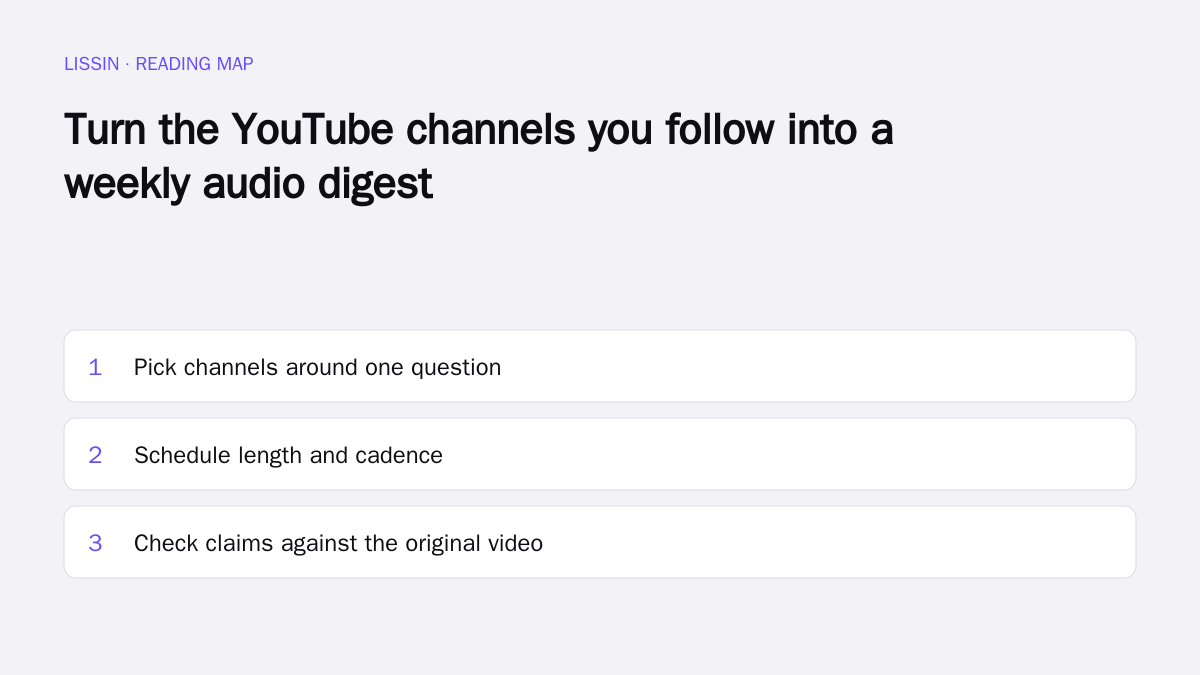
To turn several YouTube channels into a weekly audio digest, group the channels around one question. Schedule a recurring show for the slot when you actually listen. Keep the original videos close so you can check claims before you rely on them.
Lissin can follow YouTube channels as sources. A show can return daily, weekly or every two weeks, and a recurring show remembers its purpose, sources and what it has already covered (Lissin for iPhone). You want to hear what changed since last week, not each channel's background explained again.
Key Takeaways
- A digest works best when its channels answer one shared question.
- Match the cadence to how often the channels post, and the length to a listening slot you already have.
- Treat the episode as a guide to the videos. Check numbers, quotations and recommendations against the original upload.
Pick channels around one question
Start with the question, then choose the channels. "Everything I subscribe to" gives a show no editorial job. It leaves the script to decide what matters. A question tells it what to notice and what to leave out.
For a hypothetical example, say you follow three home-coffee channels. One reviews grinders, one tests brewing technique, and one covers café culture. A useful weekly question would be: What changed this week in home espresso gear and technique, and where do these channels disagree? The café-culture channel may not fit that question. You could drop it, or give it its own show.
Use this check for each channel before you add it:
| Question | Keep it if | Reconsider if |
|---|---|---|
| Does it address the show's question? | Most uploads touch the topic | It covers the topic only now and then |
| Does it post often enough for the cadence? | It usually has something new each week | Weeks often pass with nothing new |
| Would you want to know when it disagrees with the others? | Yes, the contrast is useful | It mostly repeats the others |
Choose the angle too: a skeptical take, a practical breakdown, a debate or your own editorial lens. You can also tell Lissin about your interests, goals or current situation (Lissin for iPhone). For a gear-heavy digest, a skeptical or practical lens can keep the focus on evidence over excitement. A debate format suits channels that often reach different conclusions.
If your sources are mostly written feeds, building a science show from a narrow RSS selection uses the same narrowing idea for a different source type.
Schedule length and cadence
Pick the cadence from the channels' posting rhythm and the length from your listening slot. Describe what you want, add sources, decide how it thinks and sounds, then choose a one-time episode or a recurring schedule (Lissin for iPhone).
| Schedule | Suits | Watch for |
|---|---|---|
| Daily | Channels that post most days, or news-led topics | Thin episodes if the channels post less often |
| Weekly | A handful of channels that each post about once a week | A long gap if you want same-day reactions |
| Every two weeks | Slower channels, or long tutorials and reviews | Older material by the time you hear it |
For the coffee example, start weekly if the channels usually publish each week. Shorten the cadence only if the uploads and your listening habit justify it. A faster schedule does not create more news.
For length, think about where the episode will play. Choose a length for the time you actually have, such as a quick morning update or a deep dive for a long walk (Lissin for iPhone). If your digest lands on Saturday and you listen on a walk, a longer episode may fit. If it plays during a short weekday commute, ask for something tighter. Matching episode length to a journey has a worked commute example.
If the first episode misses, change it in plain words. Remix an episode to get a new version, or remix a recurring show to change future episodes. Past episodes stay as they are (Lissin for iPhone). A note such as "less hype, more comparison between channels, and shorter" gives the next version a specific direction.
Two practical points:
- Quiet weeks. A schedule does not tell you what the show does in a quiet week. If one channel goes quiet, open that week's episode and see how it was handled. Do not assume it was skipped, padded or merged.
- Offline listening. The iPhone app supports offline downloads (Lissin for iPhone). Before a trip without signal, try playing the episode with your phone offline. If playback stops, reconnect before relying on it for the journey.
The app requires iOS 26.0 or later. Shows also play in a browser at web.lissin.com. The app is a free download, and paid plans raise how much you can generate each week (Lissin for iPhone).
A request for the coffee example might read:
Every week, follow these three YouTube channels and tell me what changed in home espresso gear and technique. Lead with anything new since last week, point out where the channels disagree, and name which channel made each claim. Practical tone, no hype.
Treat this as a starting suggestion, not a guaranteed result. Listen to the first episode and remix from there.
Check claims against the original video
A digest tells you what to watch. It is not a substitute for the video when a detail matters. Before you buy, change a setting or repeat a claim to someone else, go back to the source.
A short routine:
- Note the claim and the channel. When the episode says a channel recommended, measured or criticised something, note which channel. This is why the example request asks the script to name the source of each claim.
- Open that channel's recent uploads. Find the video from the period the episode covers.
- Check the specific detail. Prices, measurements, model names, dates and quotations are the easiest details to get slightly wrong in a spoken summary.
- Check whether a disagreement is real. Two channels may seem to disagree only because they tested different things.
How to spot hallucinations in spoken summaries covers which kinds of claims deserve a pause. Source links and corrections in generated audio explains how to trace a claim back to its record. If you lose the thread between weekly episodes, recovering context before the next show explains what a recurring show's memory can and cannot restore.
For a visual tutorial, keep the video open: an audio digest cannot show a hand position, wiring layout or before-and-after image.