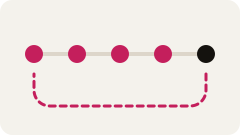
First cousin once removed: how to read the family link
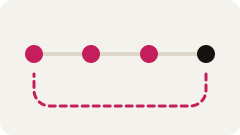
Learn what first cousin once removed means, count generations from a shared ancestor, and check a family tree against historical records.
5 min

Source-linked explanations of science, space, maths, history, time and measurement, written to be understood by ear.
Learn what first cousin once removed means, count generations from a shared ancestor, and check a family tree against historical records.
Learn the difference between true, magnetic, and grid north, then convert a hypothetical compass bearing without mixing up the sign of declination.
Water and grease do not mix, but soap can interact with both. Follow the molecule from oily tail to water-facing micelle and see how a rinse carries grease away.
Learn how to read 12-hour and 24-hour clock notation, why noon is not 12 a.m. or 12 p.m., and how to label midnight at the start or end of a date.
Read a 78 rpm record through its object data, performance metadata, transfer choices, and rights, with Library of Congress and Smithsonian examples.
Learn the difference between area and perimeter with 4 m by 6 m and 5 m by 5 m rectangles, clear units, and scaling arithmetic for a clear spoken explanation.
Convert Celsius and Fahrenheit weather readings with worked 20°C, 0°C, and −10°C examples, then learn why a 10°C change equals an 18°F change.
Learn why civil time can differ from the 15-degree ideal, with Darwin and Newfoundland examples, standard-time arithmetic and daylight-saving context.
Learn how to turn a historical letter into an audio guide by checking its address, date, purpose, original page, transcription, and context.
Learn how a refrigerator moves heat from its cabinet to the room through the evaporator, compressor, condenser, and expansion device, with source links.
Learn how to read Dewey Decimal and Library of Congress call numbers, separate classification from local shelf order, and explain a label in a sourced audio guide.
Convert litres to millilitres and back using 1,000 mL = 1 L, with bottle and recipe examples, unit symbols, comparisons, and rounding labels.
Learn what 1:25,000 means, work out 2 cm as 500 m, compare 1:50,000, and measure straight lines or routes after resizing a map.
Learn what makes a number prime, why 1 is neither prime nor composite, and how to test a number with factors, a worked example, and the Sieve of Eratosthenes.
Read print fractions such as 12/50 and A/P 3/8, then separate artist's, trial, and printer's proofs using museum collection records.
Learn pitch versus volume: frequency counts cycles in hertz, while amplitude and sound pressure describe signal strength, with 440 Hz and 880 Hz examples.
Learn why Earth’s tilt changes sunlight and day length. Compare June and December in the US, UK, Canada and Australia without predicting local weather.
Learn how water vapour, pressure, the pericarp and softened starch turn a popcorn kernel into a flake, with a worked three-kernel example and source links.
Learn how refraction, dispersion and internal reflection form primary and double rainbows, with approximate 42-degree and 50-degree ray paths.
Understand why a sundial and a clock disagree: apparent solar time, the equation of time, longitude, time zones, and daylight saving time today.
Learn why tides shift each day: the 24-hour-50-minute lunar day, local tidal patterns, and why a simple 50-minute shift is not a tide forecast.
Read Dorothea Lange's Migrant Mother using visible details, its Library of Congress record and a worked audio script.
A clear audio guide to the Gregorian leap-year rule, with a worked check of 1900, 2000, and 2100 and a careful comparison with the Julian calendar.
How oxygen, nitrogen and altitude shape aurora colours, with NASA and NOAA sources and a worked colour-band example.
Turn a chart into a spoken explanation by naming the denominator, categories and units first. Worked USGS example separates total water from freshwater.
Use a historical map's date, orientation, legend, scale, and archive record to separate what it shows from what it cannot prove.
Read a 1918 U.S. newspaper page carefully by separating its reporting, public health message, advertising logic, and later archive context.
Choose mean or median by asking whether the total or a typical observation matters, then work through a concrete delivery-time dataset.
Build a museum audio guide from an object record. Separate physical details, documented history and interpretation, with a Rosetta Stone example.
Plan a skywatching audio guide from NASA's October 2026 dates, then check local rise times, horizon and weather for a named US or UK location.
Learn to separate percentage-point differences from relative percentage change, with ONS guidance, denominator checks, and computed hypothetical examples.
Plan three audio episodes from one public lecture, with different questions, source passages and listening lengths. Worked MIT OpenCourseWare example.
Learn how altitude, orbit period, coverage, and mission purpose separate low Earth orbit from geostationary orbit.
Choose narrow NASA and ESA RSS feeds, separate feed entries from full articles, and turn a specific science question into a source-led personal audio show.
Explain a forecast's place, time window and rain probability, then keep later observations separate. A source-based plan for a short audio briefing.
A plain explanation of the Moon's five-degree orbital tilt, nodes, eclipse seasons, and the limits of promising local visibility.
A dated guide to the NASA Crew-13 mission terms, from Falcon 9 liftoff and Dragon rendezvous to station docking and crew handover.
A plain-language explanation of ESA Juice's Sept. 28, 2026 Earth gravity assist, including reference frames, orbital energy, and mission planning.
Use the official October 5 to 12 schedule to separate a Nobel announcement and citation from the research explanation that follows.
Prepare one short, source-checked audio explanation and one discussion question for World Teachers’ Day without handing lesson judgment to an AI tool.
Use World Space Week 2026's Rocket Revolution theme to build a source-led audio explainer about how a first stage returns and flies again.
Listening explains how ideas connect; flashcards test what you recall. How to alternate them, use audio in a new language, and review your own notes.